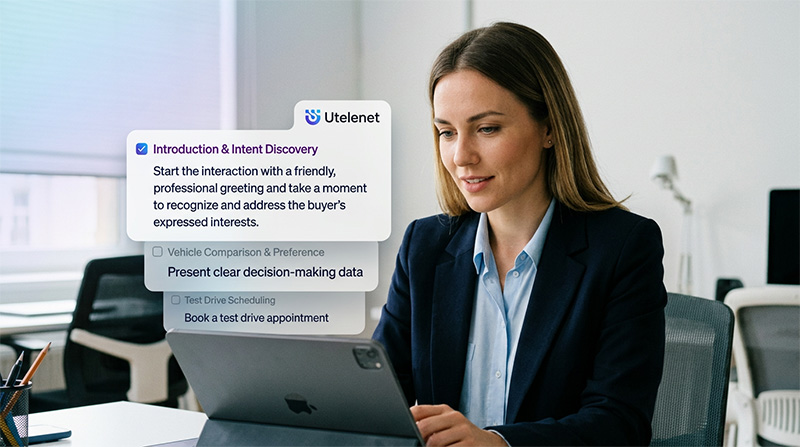
AI call summaries for revenue intelligence and faster sales follow-up
AI call summaries help sales teams understand which conversations move leads forward, where follow-up is lost and how call activity connects to revenue performance. A sales call can include a buying signal, a pricing question, an objection, a request for a demo, a callback promise or a clear next step. If that information stays only inside a recording or a short manual note, managers may not see the full value of the conversation.
Utelenet helps revenue teams connect calls, AI summaries, transcription, recordings, message history, response speed and performance analytics in one communication system. This gives sales managers a clearer view of what happened during calls and what should happen after them. A lead can call, speak with an agent, receive a WhatsApp follow-up, get an email with details and continue later with another team member while the conversation history stays easier to review.
For growing sales teams, call visibility is not only about counting calls. It is about understanding the path from the first conversation to the next action. A useful summary of the call helps agents move faster, helps managers review outcomes and helps the business protect the opportunities that already came through the phone.
Why AI call summaries matter for revenue teams
Sales communication is becoming more data-driven because companies want to understand not only final revenue, but the activity that creates it. The sales intelligence market is projected to reach USD 6.68 billion by 2030, and the call tracking software market is projected to reach USD 15.33 billion by 2030. This growth shows that businesses are investing in better ways to understand leads, conversations and sales performance.
At the same time, AI is becoming more practical inside customer communication. The call center AI market was estimated at USD 1.99 billion in 2024 and is projected to reach USD 7.08 billion by 2030. For sales teams, this matters because AI can help turn everyday calls into useful information: what the lead wanted, what was discussed, what was promised and what needs to happen next.
Utelenet uses automated call summaries as part of the sales communication workflow. The goal is not to replace salespeople or managers. The goal is to help them work with better context. Agents can spend more time speaking with customers and less time writing notes. Managers can review calls faster. Business owners can understand how phone conversations support sales activity.
- Sales managers can review call outcomes without listening to every full recording.
- Agents can follow up with more accurate context after each conversation.
- Team leads can identify buying signals, objections and unclear next steps.
- Business owners can see where leads move forward and where they slow down.
- Revenue teams can connect calls with WhatsApp, SMS and email follow-up.
- Performance dashboards can show response speed, call history and agent activity.
From call summary to sales action
A call summary should help the team act. It should not be a long block of general text that nobody reads. A strong AI call summary gives the salesperson and manager the main points: why the lead called, what they asked, what the agent answered and what should happen next.
With AI call summaries, sales teams can move from conversation to action faster. A lead who asked for pricing can receive an email. A customer who requested a demo can receive a meeting confirmation. A caller who mentioned a concern can receive a clearer explanation. A missed next step becomes easier to notice because the call context is visible.
This is where Utelenet supports revenue intelligence. The platform helps teams understand the conversation, connect it to follow-up and review performance over time. A call does not stay as an isolated event. It becomes part of the customer timeline, together with messages, recordings, transcripts and outcomes.
Which calls move leads forward
Not every sales call has the same value. Some calls are early questions. Some are serious buying conversations. Some reveal objections. Some show that a lead is ready for a proposal or a demo. Managers need to understand which calls deserve faster attention and which conversations can teach the team something useful.
AI call summaries help identify these signals more clearly. A summary can show that the lead asked about implementation, pricing, timeline, team size, onboarding, service options or contract details. These are not just call notes. They are revenue signals that help managers understand where the opportunity stands.
For sales teams, this can improve the next message. If the lead asked about a specific service, the follow-up can focus on that service. If the lead mentioned urgency, the callback can happen faster. If the lead had an objection, the manager can help the agent prepare a better answer. The sales process becomes more connected because the call history is easier to read.
Using AI call summaries to find follow-up gaps
Many sales opportunities are not lost during the call itself. They are lost after the call, when the next step is unclear, delayed or forgotten. A lead may ask for a proposal, but the email is not sent. A customer may request a callback, but the task is not visible. A conversation may include a strong buying signal, but the manager does not see it in time.
Utelenet helps teams find these gaps by connecting summaries with call history and message activity. A manager can see what the lead requested and whether the team followed up through WhatsApp, SMS, email or another call. This makes follow-up quality easier to manage because the next action is connected to the real conversation.
For agents, automated call summaries reduce the pressure of remembering every detail. For managers, they create a faster review workflow. For business owners, they show where the sales process is working and where opportunities need more attention.
- A lead asks for pricing, and the summary makes the request visible.
- A caller asks for a callback, and the team can connect the call to the next action.
- A missed follow-up becomes easier to identify in the customer timeline.
- A manager can review whether the sales message matched the conversation.
- A team lead can use real call notes for coaching and process improvement.
Response speed and the value of clear call context
Response speed is one of the strongest signals in sales communication. InsideSales reports that conversion rates are 8X higher when contact is attempted within the first 5 minutes compared with later attempts. For revenue teams, this shows why missed calls, delayed callbacks and unclear follow-up need to be visible.
AI call summaries help sales teams respond with better context after the call. A fast follow-up is stronger when it reflects what the customer actually said. A quick email, WhatsApp message or SMS reminder can feel much more professional when it includes the right next step, not a generic line.
Utelenet helps managers connect response speed with call outcomes. They can see how quickly calls were answered, which calls were missed, which agents followed up and what the conversation was about. This gives revenue teams a practical way to improve speed without losing quality.
How managers use AI call summaries with outcomes and history
Managers need to see outcomes, not only activity. A salesperson may handle many calls, but the manager still needs to understand which calls produced next steps. Did the lead request a demo? Was a proposal promised? Did the customer ask for more information? Did the agent answer the objection clearly? Did the conversation continue after the call?
Utelenet helps managers review outcomes through summaries, call history, recordings, transcription and message history. A call summary gives the main point. A transcript gives more detail when deeper review is needed. Message history shows whether follow-up happened. Analytics shows performance across agents and teams.
This creates a clearer manager dashboard. Sales leaders can review not only how many calls happened, but what those calls created. They can see where opportunities are moving, where follow-up slows down and where agents may need coaching.
Performance visibility for agents and teams
Revenue intelligence becomes stronger when managers can compare activity and outcomes across agents and teams. One agent may answer quickly. Another may write stronger follow-ups. One team may recover missed calls faster. Another may handle more complex conversations. A good system helps managers see these differences fairly.
Utelenet connects AI call notes with performance analytics. Managers can review answered calls, missed calls, response speed, outbound activity, call outcomes and follow-up quality. They can also review summaries and transcripts to understand the conversation behind the numbers.
This helps coaching become more useful. A manager can show an agent where the lead gave a buying signal, where the next step was unclear or where a strong call can become a team example. Feedback becomes more specific because it is based on real conversations and real outcomes.
Call history and message follow-up in one revenue workflow
Sales conversations often continue across several channels. A lead may call first, receive a WhatsApp message, read an email and then ask another question later. If the team cannot see the full communication history, the next response may feel disconnected.
Utelenet helps keep calls and messages connected. A summary of the call can sit next to message history, transcript, recording and analytics. This gives the next team member more context before contacting the customer again. It also helps managers see whether the team is continuing conversations properly.
This is useful for inbound sales, BPO sales teams, SaaS demo workflows, ecommerce sales calls, financial service inquiries and service businesses that depend on fast lead response. The exact sales process may change by industry, but the need is the same: understand the call, act quickly and keep the customer journey moving.
Why Utelenet fits AI call summaries workflows
Utelenet fits AI call summaries workflows because it connects call summaries with the rest of the revenue communication process. Sales teams can manage calls, missed calls, response speed, recordings, transcription, message follow-ups, call history and performance analytics from one platform.
The platform helps managers understand which conversations move leads forward, where follow-up is lost and how agents perform across calls and messages. It also helps agents continue conversations with better context, reducing the need to rely only on memory or scattered notes.
For growing revenue teams, Utelenet turns call summaries into practical business information. A call becomes easier to review, easier to continue and easier to connect to the next step. This helps sales managers, team leads and business owners make better decisions from real customer conversations.
Conclusion: better call notes for stronger revenue visibility
Sales growth depends on many small communication moments: the first call, the speed of response, the clarity of the next step, the quality of the follow-up and the manager’s ability to see what happened. When these moments are connected, sales teams can protect more opportunities and understand performance with more confidence.
AI call summaries help revenue teams turn phone conversations into clear call notes, visible outcomes and better follow-up workflows. Utelenet connects automated call summaries with transcription, recordings, message history, response speed and performance analytics, so managers can see which calls move leads forward and where the sales process needs attention.
For businesses that depend on inbound calls, outbound calls and fast follow-up, AI call summaries are not just a convenience. They are a practical layer of revenue intelligence that helps teams act faster, coach better and turn more conversations into measurable sales opportunities.