AI Answering Service for faster call response, smarter routing and better follow-up
An AI Answering Service helps business teams respond to incoming calls with more speed, structure and context. A customer may call with a sales question, a support request, a booking need, an account update or a simple question that should not wait. When the team is busy, calls can be missed, delayed or sent to the wrong person. Utelenet helps companies use AI inside the phone workflow to answer faster, route calls more clearly and keep better context after the conversation.
Utelenet is built for teams that need more than a basic phone line. The platform brings AI phone answering, cloud PBX, IVR, routing, missed call visibility, call summaries, transcription, recordings, message follow-ups and analytics into one communication system. This helps sales, support, service, BPO, SaaS, ecommerce, healthcare, finance and remote teams manage conversations with better visibility.
A practical AI Answering Service does not need to replace operators or remove the human team from customer communication. The stronger approach is to let AI support the team: answer faster when agents are busy, help route the caller, capture the main context, create a call summary, prepare the next step and make follow-up easier. Human agents still handle the relationship, the decision and the sensitive parts of the conversation.
Why AI Answering Service tools are becoming important for business communication
AI is becoming a normal part of customer communication because companies want faster response, better customer experience and more useful call data. The global call center AI market was estimated at USD 1.99 billion in 2024 and is projected to reach USD 7.08 billion by 2030. The conversational AI market is also expanding, with forecasts showing growth from USD 17.05 billion in 2025 to USD 49.80 billion by 2031.
These numbers show a clear direction. Businesses are looking for tools that can help teams manage conversations more efficiently. The contact center software market is projected to grow from USD 77.82 billion in 2026 to USD 263.75 billion by 2034, showing that companies are investing in platforms for call management, routing, analytics and customer communication.
For growing teams, the value of an AI Answering Service is practical. It helps reduce the risk of missed calls, supports faster routing and gives managers more visibility into what happens after customers contact the business. The goal is not to create a cold automated wall. The goal is to make the first response faster and the handoff to the right person smoother.
- AI phone answering can help respond when the team is busy or call volume rises.
- Call routing can help send customers to the right team, department or agent.
- AI summaries can capture the main point of the conversation after the call.
- Transcription can turn spoken calls into readable text for review.
- Missed call visibility helps teams recover conversations that were not answered.
- Analytics helps managers understand response speed, call volume and team performance.
How AI helps reduce missed calls without removing the human team
Missed calls are one of the most common communication problems for growing businesses. A call can be missed because agents are already speaking with customers, the front desk is overloaded, the sales team is handling another lead or the support queue is busy. These moments are normal, but they still create gaps in customer communication.
Utelenet helps teams manage this problem by making call activity more visible and structured. AI call answering can support the first response, while routing and queues help organize where the call should go. If a call is still missed, the system can help managers see it and prepare follow-up. This makes missed calls easier to recover instead of leaving them hidden in phone history.
For sales teams, this can help protect new inquiries. For support teams, it can reduce repeated customer attempts. For service teams, it can help keep appointments, updates and customer questions moving. The human team stays important, but the phone system becomes smarter around the moments when people are not immediately available.
What an AI Answering Service should do during an incoming call
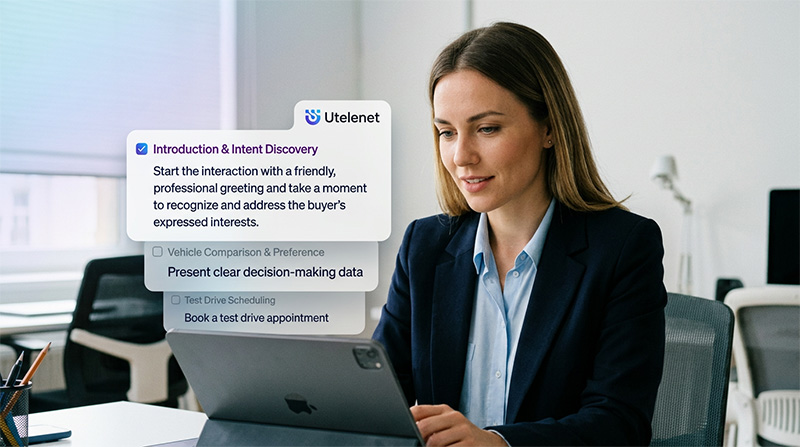
A useful AI Answering Service should help the caller move in the right direction. It should not make the process feel complicated. When a customer calls, the system should help identify the reason for the call, guide the customer to the right path and support a smoother handoff when a human agent is needed.
In Utelenet, AI phone answering can work together with IVR, routing and call history. A caller may need sales, support, billing, appointments, delivery, account help or another department. The system can help organize the call journey so the customer does not feel lost and the team receives better context.
This is especially useful for companies that receive different types of calls throughout the day. A retail store may receive order questions and return requests. A SaaS company may receive demo calls and support calls. A clinic may receive appointment calls. A financial service team may receive new inquiries and account questions. The call path should match the business workflow.
Routing calls faster to the right person or team
Fast routing can improve the first experience of the call. Customers usually do not want to repeat the same information several times. They want to reach the person who can help. IVR, routing and AI call answering can work together to make that first step clearer.
Utelenet helps teams create routing flows for departments, groups, queues and users. A new lead can reach sales. A support request can reach the right support team. An account question can go to the right department. A missed or overflow call can be tracked for follow-up. This helps businesses manage demand without relying only on manual transfer.
Routing is also useful for managers. If too many calls go to one department, analytics can show the pressure. If one queue receives more missed calls, the team can adjust coverage. If certain call types increase after a campaign, managers can understand the pattern and improve the flow.
AI summaries and call context after the conversation
The value of AI does not end when the call ends. In many cases, the most useful part begins after the conversation. The team needs to know what happened, what the customer asked, whether the issue was solved and what should happen next. Without a clear summary, agents may rely on memory or short manual notes.
An AI Answering Service inside a wider phone system can help capture this context. AI summaries can show the main topic of the call. Recaps can help identify the next step. Transcription can preserve the conversation in text. Call history can connect the call with messages and follow-ups.
This is useful for sales and support teams because customer journeys often continue over time. A lead may call today and receive an email tomorrow. A support customer may call again later and speak with another agent. A manager may need to review what happened before approving the next action. Context makes every next step easier.
Transcription and recordings for review, quality and manager visibility
Recordings are useful when teams need the full conversation. Transcription makes review faster because it turns voice into text. Managers can scan a conversation, search for important details and understand what was said without listening to the full recording every time.
Utelenet connects recordings, transcription and AI summaries with the rest of the communication workflow. This gives managers a better way to review calls for quality, coaching and follow-up. A sales manager can review lead questions. A support manager can understand repeated issues. A team lead can find calls that are useful for training.
Salesforce reports that service teams using AI agents expect service costs and case resolution times to decrease by an average of 20%. For customer-facing teams, this direction is important because faster access to call context can help agents and managers work more efficiently. Utelenet supports that idea by making conversation review faster and more organized.
Follow-up after AI answered calls
The next step after the call can be just as important as the call itself. A customer may need a WhatsApp message, SMS reminder, email confirmation, callback, proposal, support update or document request. If the team does not follow up clearly, the call can lose value.
Utelenet helps connect AI call answering with follow-up workflows. A call can be answered, routed, summarized and continued through message history. The team can see what happened and choose the right next action. This helps reduce manual gaps and gives managers better visibility into whether follow-up was completed.
For sales teams, follow-up may protect a lead. For support teams, follow-up may complete the service experience. For operations teams, follow-up may confirm an appointment, delivery or next step. The system helps the team move from conversation to action with less friction.
AI Answering Service for sales, support and service teams
AI Answering Service workflows can support several types of teams. Sales teams can use AI call answering to reduce missed inquiries, route leads and capture call context. Support teams can use it to organize common requests, preserve conversation details and make the next step clearer. Service teams can use it for appointments, confirmations, callbacks and routine customer questions.
For BPO and contact center teams, AI phone answering can help manage high call volume together with queues, routing, recordings, summaries and performance analytics. For remote teams, it can create one shared communication layer even when agents work from different locations. For managers, it creates a clearer view of calls, missed calls, response speed and follow-up.
Utelenet is useful because it does not treat AI as a separate tool. AI works inside the communication process. Calls, routing, summaries, transcripts, messages and analytics support the same customer journey. This makes AI practical for daily work, not just an extra feature.
How analytics helps managers understand AI call answering performance
AI phone answering becomes more useful when managers can measure what happens. A manager needs to know how many calls came in, how many were answered, how many were routed, how many were missed and which calls needed follow-up. Without analytics, AI answering is difficult to manage properly.
Utelenet gives managers a dashboard view of communication performance. They can see call volume, missed calls, response speed, agent activity, routing patterns and follow-up activity. AI summaries and transcription add context, so managers can understand not only that a call happened, but what it was about.
This helps teams improve over time. If certain calls are often routed to the wrong department, the flow can be adjusted. If call volume rises after a campaign, managers can prepare coverage. If missed calls increase during specific hours, the team can create stronger callback workflows. Analytics turns answering into a managed process.
Why Utelenet fits AI Answering Service workflows
Utelenet fits AI Answering Service workflows because it combines AI call answering with the tools businesses already need: cloud PBX, IVR, routing, queues, missed call visibility, recordings, summaries, transcription, follow-ups and analytics. This gives teams a complete communication environment, not only an automated answer at the beginning of the call.
The platform is useful for sales teams, support teams, service teams, BPO operations, SaaS companies, ecommerce stores, healthcare providers, financial service teams and remote teams. Each team may use AI differently, but the goal is the same: answer faster, route smarter, keep context and follow up clearly.
Utelenet helps companies improve communication without promising that AI should fully replace operators. The strongest value comes when AI supports human teams, reduces repetitive work and gives managers better visibility into the full call journey.
Conclusion: smarter answering that supports the whole team
Customer calls still matter because many people want quick, direct answers. The challenge is managing those calls when teams are busy, call volume rises or customers need to reach the right person quickly. AI can help by supporting the first response, guiding routing, capturing context and preparing the next step.
An AI Answering Service helps businesses reduce missed call risk, improve response speed, capture call context, create summaries, support transcription and manage follow-up after conversations. Utelenet brings these tools into one cloud communication platform for teams that want smarter answering and clearer daily workflows.
For growing companies, an AI Answering Service is not a replacement for great people. It is a practical way to help teams answer faster, work with better context and manage every customer call with more confidence.